

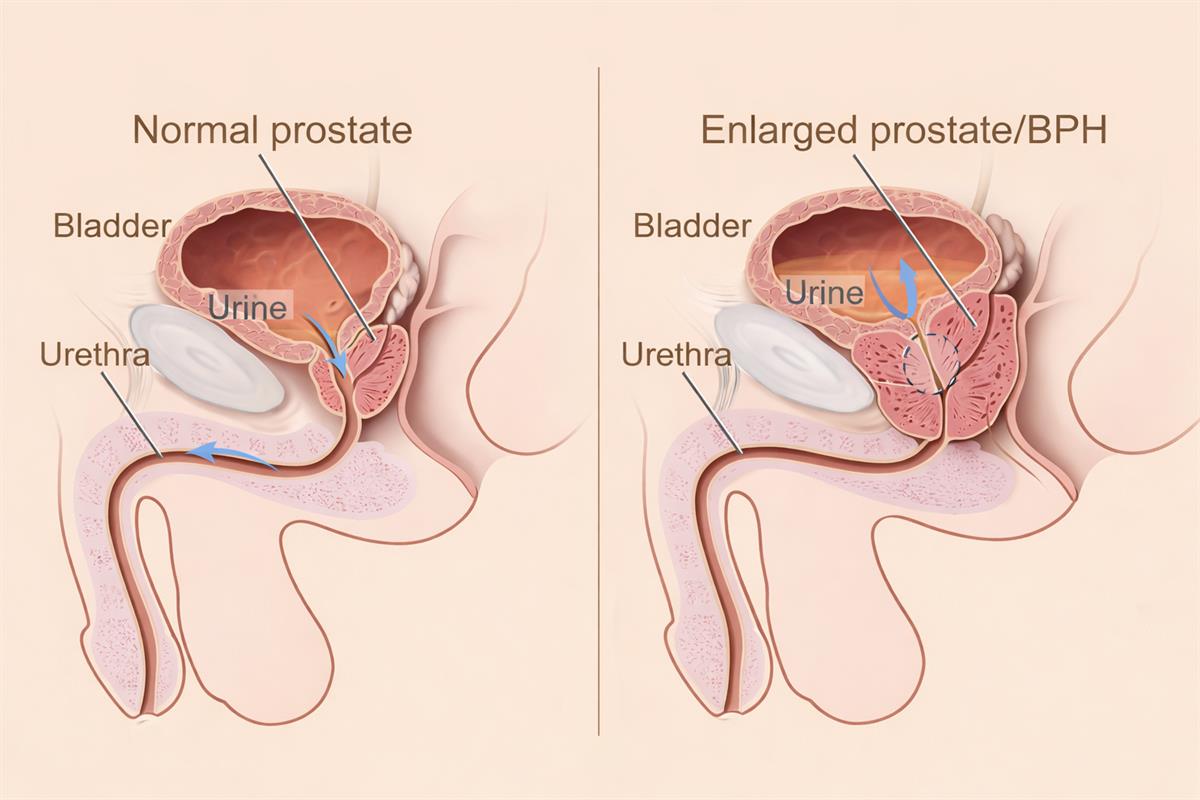
Benign Prostatic Hyperplasia (BPH)
Benign Prostatic Hyperplasia is a non-cancerous enlargement of the prostate gland that commonly affects men as they age.The enlarged prostate presses on the urethra and bladder, leading to difficulty in passing urine.
It is a progressive condition but can be effectively managed with timely treatment.
Cause
With increasing age, hormonal changes—especially involving testosterone and dihydrotestosterone—cause gradual growth of the prostate gland.As the prostate enlarges, it narrows the urinary passage and interferes with normal bladder emptying.
Common Symptoms
- Frequent urge to urinate, especially at night
- Weak or slow urine stream
- Difficulty starting urination
- Feeling of incomplete bladder emptying
- Dribbling at the end of urination
- Sudden urgency to pass urine
- In severe cases, inability to pass urine (acute urinary retention)
When to Seek Medical Help
- Symptoms persist or progressively worsen
- Night-time urination repeatedly disturbing sleep
- Increasing difficulty in starting urine flow or very weak stream
- Sudden inability to pass urine
- Pain or burning sensation during urination
- Blood in urine
- Repeated urinary tract infections
- Lower abdominal pain, bladder fullness, or discomfort
- Urinary symptoms interfering with daily activities or work
Early consultation helps prevent complications involving the bladder and kidneys.
Risk Factors
- Increasing age, especially above 50 years
- Hormonal imbalance related to aging
- Family history of prostate enlargement
- Diabetes and metabolic syndrome
- Obesity and sedentary lifestyle
- Chronic alcohol consumption
- Certain medications affecting bladder or prostate function
How is BPH Diagnosed
- Clinical history and symptom assessment
- Digital rectal examination (DRE)
- Ultrasound of prostate and bladder
- Uroflowmetry to assess urine flow
- PSA blood test to exclude prostate cancer
- Urine examination to rule out infection
Treatment Options for BPH
Conservative Management
- Recommended for mild symptoms
- Reducing fluid intake at night
- Limiting alcohol and caffeine
- Timed voiding and bladder training
Medical Treatment
- Alpha blockers to relax prostate and bladder neck muscles
- 5-alpha reductase inhibitors to reduce prostate size
- Combination therapy for moderate to severe symptoms
- Requires regular follow-up and monitoring
Surgical Treatment
Surgical treatment is advised when symptoms are severe, medications fail, or complications such as urinary retention, recurrent infections, bladder stones, or kidney damage develop.The choice of procedure depends on prostate size, patient health, available technology, and surgeon expertise.
TURP (Transurethral Resection of the Prostate)
TURP is the most established surgical treatment for BPH.A resectoscope is passed through the urethra without any external cuts.
Excess prostate tissue blocking urine flow is shaved off using electric current. This widens the urinary passage and improves urine flow.
- Best suited for moderate to large prostates.
- Provides long-term symptom relief.
- Hospital stay is usually 2–3 days.
- Temporary catheter is required for a few days.
- Possible side effects include retrograde ejaculation, temporary bleeding, and rarely urinary incontinence.
Laser Prostate Surgery (Laser TURP / HoLEP)
Laser surgery uses high-energy laser beams to remove or vaporize enlarged prostate tissue through the urethra.HoLEP (Holmium Laser Enucleation of Prostate) removes the obstructing portion of the prostate and is effective even for very large glands.
- Minimal blood loss and safer for patients on blood thinners.
- Shorter hospital stay and faster recovery compared to TURP.
- Catheter duration is usually shorter.
- Provides durable, long-term results similar or superior to TURP.
- Retrograde ejaculation is common, but erectile function is usually preserved.
Bipolar TURP
This is a modified version of standard TURP using bipolar energy instead of monopolar current.It allows surgery using saline irrigation, reducing the risk of fluid absorption complications.
- Safer for elderly patients and those with heart conditions.
- Similar effectiveness to conventional TURP.
- Lower risk of electrolyte imbalance.
Open Prostatectomy
This is an open surgical procedure performed through a lower abdominal incision. The enlarged inner part of the prostate is removed manually.
- Reserved for very large prostates usually above 80–100 grams.
- Used when endoscopic procedures are not suitable.
- Longer hospital stay and recovery period.
- Provides excellent symptom relief but has higher surgical morbidity compared to endoscopic methods.
Laparoscopic or Robotic Simple Prostatectomy
This is a minimally invasive alternative to open surgery for very large prostates.Small keyhole incisions are used to remove the enlarged prostate tissue with laparoscopic or robotic assistance.
- Less pain and blood loss compared to open surgery.
- Shorter hospital stay and quicker recovery.
- Requires advanced surgical expertise and infrastructure.
Transurethral Incision of the Prostate (TUIP)
In this procedure, small cuts are made in the prostate to relieve pressure on the urethra without removing tissue.
- Best suited for smaller prostates with bladder outlet obstruction.
- Short operative time and quick recovery.
- Lower risk of sexual side effects.
- Symptoms may recur over time in some patients.
Recovery After Surgery
- Most patients notice significant improvement in urine flow within days to weeks.
- Temporary burning during urination or mild blood in urine can occur.
- Normal daily activities can usually be resumed within 2–4 weeks depending on the procedure.
- Heavy lifting and strenuous activity should be avoided during early recovery.
- Regular follow-up is important to monitor urinary function and detect late complications.
Complications if Untreated
- Recurrent urinary tract infections
- Acute urinary retention
- Bladder stones
- Bladder wall damage
- Kidney damage due to back pressure
Outlook
Benign Prostatic Hyperplasia is a common and manageable condition.Early diagnosis and appropriate treatment significantly improve urinary symptoms and quality of life while preventing long-term complications.